Brand new scientific releases of 2026
The project might have come to an end, but our research work is far from over!
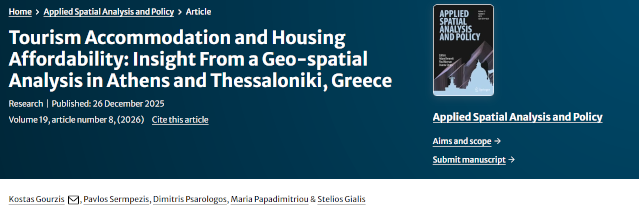
🔸Starting with the paper entitled “Tourism Accommodation and Housing Affordability: Insight From a Geo-spatial Analysis in Athens and Thessaloniki, Greece” looks at short-term and residential rental market separately, explores and understands their connection through spatial and non-spatial analysis.
Some of the key findings indicate that:
- Short-term rental concentration is associated with higher residential rents in both Athens and Thessaloniki.
- This relationship is not uniform across space — its intensity varies significantly between neighborhoods.
- Higher Airbnb prices tend to coincide with higher long-term rents, linking tourism profitability to local housing markets.
- Rising rents are closely tied to higher housing sale prices, indicating broader investment-driven dynamics beyond tourism alone.
The paper can be accessed through ResearchGate, and by clicking the link below: https://link.springer.com/article/10.1007/s12061-025-09771-2
———

🔹The second paper entitled “The evolving modalities of gentrification in Athens vis-à-vis Greece’s shifting growth models: Insight from a novel multi-scalar approach”, looks at how gentrification has unfolded in Athens over time, while exploring how different waves of change reshaped the city’s inner neighbourhoods. Focusing on the period up to the 2004 Olympic Games, it shows how two main waves of gentrification transformed central Athens during a phase of growth driven largely by urban expansion.
Its main findings indicate that:
- Gentrification in Athens isn’t a single, uniform process, but it shifts depending on economic priorities.
- As Greece’s economy became more dependent on tourism and financial investments, gentrification adapted to support those sectors (e.g., by converting housing into tourist accommodation).
- The process helps local capital extract value from urban space — meaning it reshapes neighborhoods in ways that benefit investors and tourism-related interests more than long-term residents.
The paper can be accessed through the link below: https://journals.sagepub.com/doi/epub/10.1177/09697764251407087
———
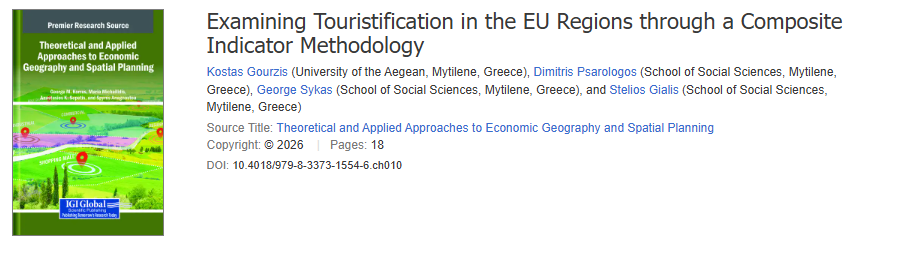
🔸Finally, at the book entitled “Theoretical and Applied Approaches to Economic Geography and Spatial Planning”, our researchers have contributed to its composition, through the chapter entitled “Examining Touristification in the EU Regions through a Composite Indicator Methodology”. In this chapter our team introduces the Touristification Index (TAIDD CI): an index that measures the territorial and social pressures from tourism’s supply and demand, as well as regions’ dependence on tourism in terms of employment and output. By applying this index to all EU NUTS-2 regions, from 2009 to 2022, this chapter brings some interesting key findings. These findings indicate that:
- Touristification in the EU is highly uneven but spatially stable over time, despite major economic crises.
- Three main touristification zones dominate: Southern sun-and-sea regions, Alpine areas, and major European cities.
- A strong North–South divide persists, with Southern EU regions far more touristified than Northern and Eastern ones.
- Within the EU South, Greece, Portugal, and Croatia have deepened tourism dependence, unlike the more diversified Spain and Italy.
The chapter can be accessed through ResearchGate, and by clicking the link below: https://www.igi-global.com/chapter/examining-touristification-in-the-eu-regions-through-a-composite-indicator-methodology/398328
Discover more about the Inclusive Urban Societies project by visiting its official website, and dive into the insights of labour and housing markets through the project’s “Labour and Housing Observatory”.
Also, follow up and keep in touch with us through our social media platforms:
Facebook
Or contact us at our e-mail address urbaninclusion@aegean.gr


